


GTA 6 Development: What Bloomberg’s Jason Schreier Uncovered
Three directors, two delays, leaks, crunch and a union fight: the biggest takeaways from Bloomberg’s inside look at how Rockstar made GTA 6, plus our take.
For the first time, Rockstar Games has spoken on the record about how hard GTA VI was to make. On October 14, 2026, Bloomberg Businessweek published “The Making of Grand Theft Auto VI” by Jason Schreier, who spent a full day at Rockstar North in Edinburgh interviewing the studio’s top brass. It’s the cover story of the magazine’s November issue and, with the game landing on PS5 and Xbox Series X|S on November 19, the most detailed account yet of how it came together.
Below are the points from Schreier’s piece that matter most to players, with some context from us and our own take at the end. The charts are our own, built from the data Bloomberg published.

Why this story matters
Rockstar almost never opens up about how it works. Doing so with Schreier is notable: no journalist has covered the studio more closely over the past decade. He reported on the 60-hour weeks behind Red Dead Redemption 2, chronicled Rockstar’s internal culture shift in 2022 and was first to report that GTA VI would star a Latina protagonist. He’s also the author of two of the best-known books about the industry, Blood, Sweat, and Pixels and Press Reset.
This time, instead of relying on anonymous sources, Schreier sat down in late September with:
- Jennifer Kolbe, Rockstar’s head of publishing.
- Rob Nelson, Aaron Garbut and Phil Hooker, the game’s three heads of development.
- Jonathon Ashcroft, senior vice president of technology.
The story also features Strauss Zelnick, CEO of Take-Two, and Rachel Crawford, one of the employees fired in 2025.
Schreier paints a picture of a studio in the final stretch, with bug-tracking dashboards where green tiles now outnumber red, and a culture of secrecy that spills onto the street: some fans stake out the building or count late-night pizza orders to guess when a milestone is near.

GTA VI by the numbers
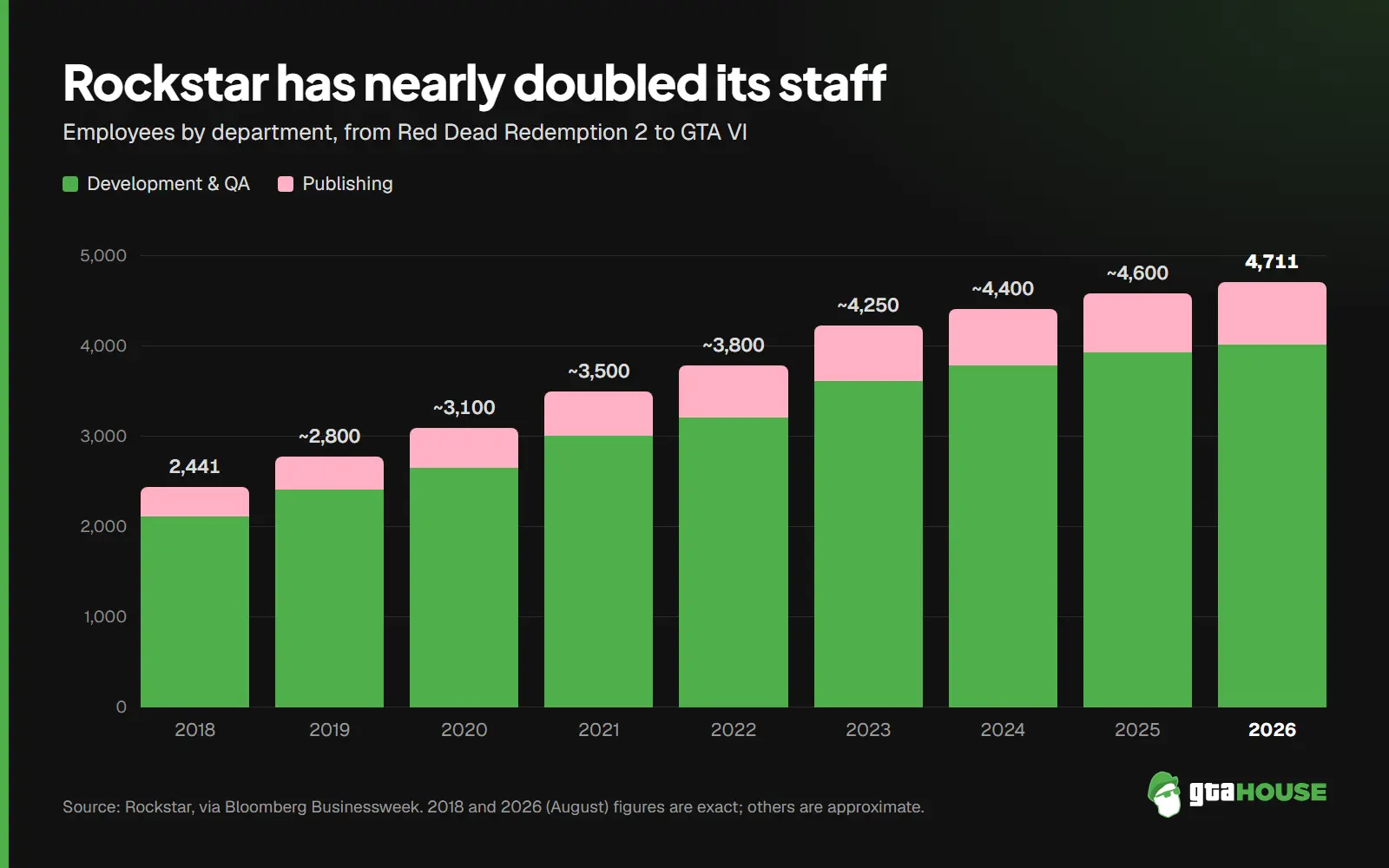
Bloomberg’s figures show just how big this project is:
Metric | Figure |
|---|---|
Rockstar headcount at Red Dead Redemption 2’s launch (2018) | 2,441 |
Headcount as of August 2026 | 4,711 across 12 studios |
Development time | More than eight years (first Miami research trip in 2015) |
GTA V sales | 230 million copies |
First trailer views | 93 million in 24 hours; nearly 300 million overall |
Some analysts’ forecast | 40 million copies and over $3 billion in the first four months |
Estimated GTA Online revenue | Around $500 million a year |
Budget | Undisclosed; Kolbe denies it topped $1.5 billion |
Rockstar won’t share the budget, but Kolbe did shoot down the popular claim that GTA VI cost more than Dubai’s Burj Khalifa (roughly $1.5 billion). Even so, given the headcount and timeline, Schreier calls it almost certainly the most expensive game ever made. One note for online players: GTA VI’s online component is expected in 2027, though Rockstar isn’t discussing it yet.

It started as “Project Americas”
GTA VI goes back further than most people assumed. In 2015, Rob Nelson and other veterans flew to Miami on a research trip for a project codenamed “Project Americas”, which originally aimed to span parts of both North and South America. That scope was later cut down to Vice City and its surroundings, the state we now know as Leonida.
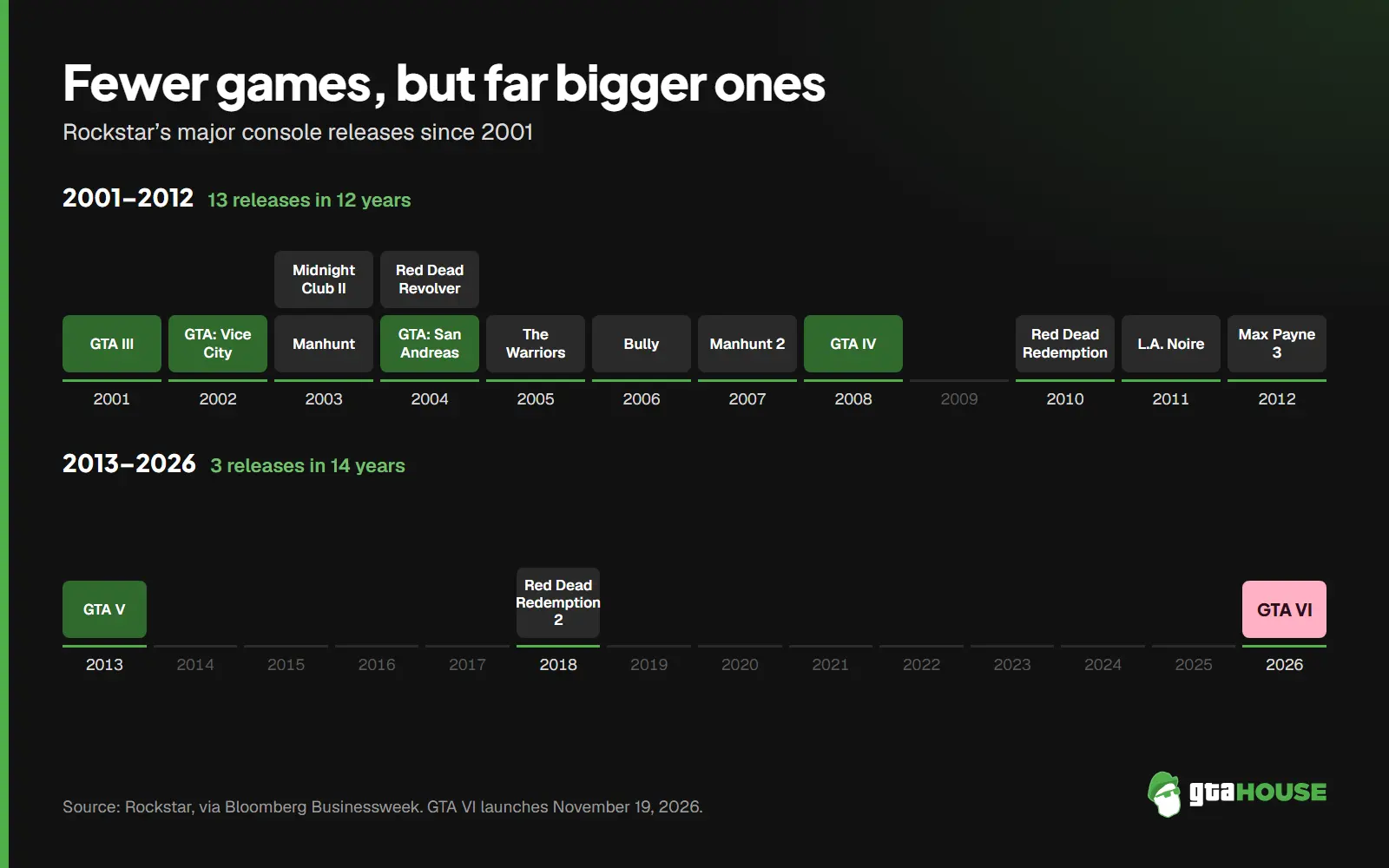
The plan was to build it alongside Red Dead Redemption 2, but the western grew so large that it pulled in nearly the entire company. Since then, Rockstar has focused on one major game at a time, which is why Red Dead Redemption 2 is the only big release between GTA V (2013) and GTA VI (2026).
Three leaders, no Dan Houser
After Red Dead Redemption 2, several key figures left, including Dan Houser, lead writer on most of Rockstar’s games. Rather than one successor, the studio named three: Nelson, Garbut and Hooker all became heads of development, an unusual setup in an industry that typically has a single director.
Some staff complained about indecision and clashing visions. Nelson acknowledges it calmly: nobody said it to his face, but he knows people felt that way. His counterpoint is that a single director can be just as slow or just as prone to changing their mind. Nelson also discussed Leonida’s design in his Famitsu interview.
The “dark period”: realism, a pandemic and a couple
By late 2019, the story’s backbone was in place: Jason Duval and Lucia Caminos, a criminal couple in a fictional Miami. Everything else was harder. Nelson describes this phase as “a dark period”, when the game’s vision still wasn’t clear.
The biggest question was how far to push realism. With visuals this detailed, a beer simply materializing in a character’s hand looks wrong. But should players have to open the store fridge, carry the bottle to the counter and pay? Should they have to buy groceries to make a stat-boosting sandwich? Many of these calls were guesswork, because so much of the game didn’t exist yet.
Schreier later gave a telling example in a follow-up video: GTA VI has a dedicated sweat system. Jason, Lucia or anyone else sweats more or less depending on how hard they exert themselves; dance hard in a nightclub and you'll end up far damper than if you stand still. To Schreier, details like this are one of the main reasons development took so long.
Then came the pandemic: months of working from home, motion-capture stages shut down and a hiring surge that made communication harder. Some senior designers quit, frustrated by the lack of progress.

By 2022, the pieces were starting to fit, and the team committed to what the story frames as the game’s defining feature: letting Jason and Lucia do everything together in the open world. That meant years of work on AI systems (“the traditional kind, not ChatGPT,” Schreier notes), and there was internal hesitation, but the argument that this is a game about a couple won out. The payoff: you can text Lucia to meet up, stroll hand in hand through a park, hit the gym together, or rob a store and flee the cops while the two of them banter.


The 2022 leak and the end of remote work
In September 2022, just as the game was gelling, a phishing attack gave a hacker access to Rockstar’s Slack, and dozens of clips of unfinished GTA VI leaked online. Aaron Garbut compares it to “somebody wading through your dirty washing”: seeing early work that was never meant to be public.
The fallout inside the studio was controversial. In 2024, Rockstar required everyone to work from the office five days a week, citing security, and blocked access to the game’s tools from home, so staff who had to stay in for childcare had to burn vacation days. Kolbe says the policy will be reviewed after launch, but doubts it will become a standard hybrid setup because the game is such a target. The irony: another major leak hit in August 2026, right before An Extended Look premiered on Netflix, and some employees grumbled that the sacrifice had been for nothing.
Was there crunch on GTA VI?

Red Dead Redemption 2 was the turning point. After months of 60-hour weeks, Kolbe says leadership agreed it would never work that way again, and told staff in writing that GTA VI would not be finished through crunch. The fixes included hiring more people, setting more realistic schedules, tracking progress more closely and offering paid time off, and sometimes extra pay, for overtime.
Kolbe doesn’t claim it was perfect. She admits someone will always say they did put in extra hours, but argues things were handled better than on Red Dead Redemption 2. Schreier adds that most employees he’s spoken to over the years are positive about the studio’s cultural changes, including the departure of managers seen as abusive.
The 34 firings and the union push

The thorniest topic is the firing of 34 employees in 2025, most of them involved in an effort to unionize. Rockstar says they were dismissed for sharing confidential information on a Discord server with hundreds of members, including former staff; the group disputes that. The case is before an employment tribunal in Glasgow, with a ruling expected at the end of October 2026, and the former employees are seeking reinstatement or compensation.
Rachel Crawford, one of those fired, says they wanted a union precisely so recent improvements wouldn’t depend on management’s goodwill alone. The effort didn’t stop: over the summer the group requested voluntary recognition and now meets management weekly. Kolbe calls the process positive and sums up her stance simply: if the team wants a union, it will have one.
Why GTA VI was delayed twice
The first trailer, released in December 2023, promised a 2025 launch, and leadership says it genuinely believed that at the time (rank-and-file staff were less convinced). Ashcroft explains that trailers are the best internal compass for a team of thousands: nothing aligns people like one.
As the date approached, the team asked for more time. Kolbe called Strauss Zelnick to push the game to May 26, 2026, then called again months later to move it to November 19. His reaction, as Kolbe tells it: “Please tell me you’re kidding.” He came around once they explained why.
There was no single disaster, just lots of moving parts that didn’t progress fast enough. The clearest example is non-player characters: when the team projected how many NPCs it still had to write and animate, Nelson calls the numbers “horrifying.” Rockstar’s answer was to quickly spin up a Los Angeles studio devoted entirely to them. As Hooker puts it, they could have hit the date, but it wouldn’t have been the game they wanted to make.
Two hours, zero story missions
The story that best sells the game comes from Hooker. Playing a late build, he was heading to a mission when another driver rammed him and got out to yell. Low on health, he wandered into a store, got into a fight with another pedestrian, robbed the empty register, escaped the police, stole a valuable car, tailed another one blasting music to a compound full of loot, sold it all to a fence and picked up a fresh tip. Two hours later, he still hadn’t reached the mission. That session, he says, convinced the team they had something special.

Will Rockstar’s next game take this long?
Its leaders say no. Hooker and Garbut argue that the engine, tools and team built for GTA VI are a foundation for producing content much faster, and they promise the next release won’t take another eight years. Their reference point is the jump from GTA III to Vice City, made in under a year on top of existing work. Garbut is blunt about it: they rebuilt a lot for this project, but it’s done now, and they won’t tear it apart.

Our take
Schreier’s reporting makes three things clear. First, the couple is GTA VI’s real innovation: not a story device but a gameplay system that took years and real doubts, and the thing that will set it apart most from GTA V. Second, the tone leans closer to Red Dead Redemption 2 than to GTA V: Rockstar wants us to care about Jason and Lucia without giving up the satire or the chaos. Third, the studio has changed as much as the game: nearly twice the staff, new ways of working, and open wounds like the Glasgow tribunal that are worth keeping an eye on.
What’s most striking is that Rockstar chose to tell this story at all. After years of silence, owning up to a “dark period,” the delays and the missteps is also a way of managing expectations ahead of the most scrutinized launch in gaming history. If the promise of not waiting another decade for the next game holds, that may be the best news in the whole piece.
If you want the full picture, Jason Schreier’s complete feature on Bloomberg goes into much more detail about daily life inside Rockstar North.


